
Views: 0 Author: Site Editor Publish Time: 2026-11-23 Origin: Site
Most fiber optic splice closures do not fail because the dome or inline body is weak. They fail at the points where the cable enters the housing, and at the mid-span window where a live cable is opened without being cut. Those two details decide whether an IP68 rating on the datasheet still means anything five or ten years later, after thermal cycling, re-entry, and repeated mechanical load on the cable.
This guide is for operators, integrators, and government project teams who specify or install outdoor plant. It covers how mid-span access actually works, how to choose cable-port sealing, how to plan in-out counts before ordering, and which installation habits most often undo a good enclosure.
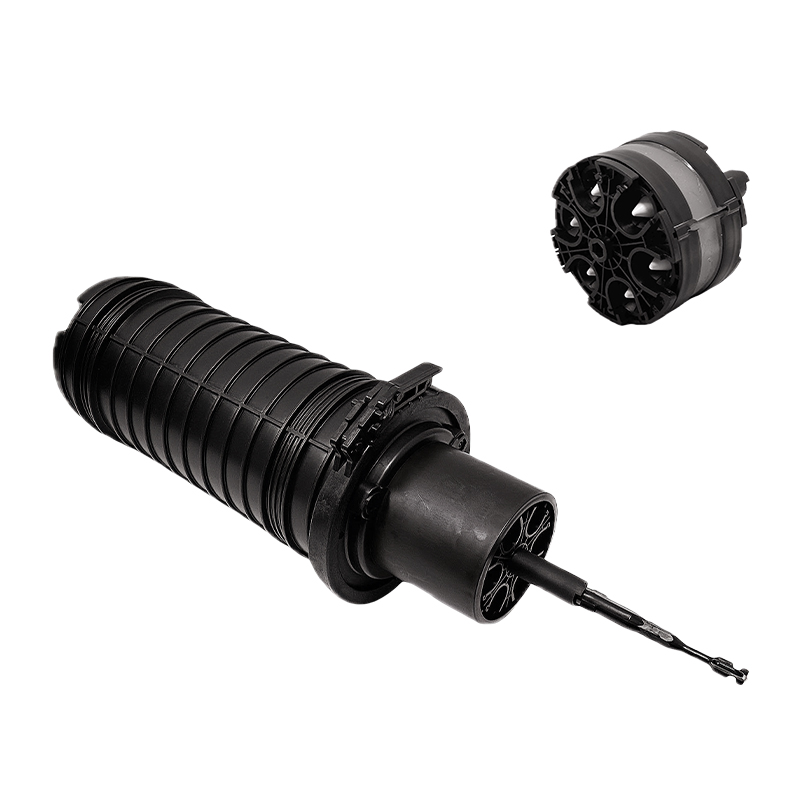
Dome splice closure with oval mid-span cable entry
A closure is a sealed volume with three usual leak paths:
The main housing seal — the dome clamp and O-ring, or the inline cover gasket.
The cable ports — oval or round ports where feeder, distribution, and drop cables pass through grommets, mechanical compression seals, or heat-shrink sleeves.
The mid-span opening — a window cut in the cable sheath so selected fibers can be branched while the uncut strength members and remaining fibers continue through the closure.
If the housing seal is assembled to the manufacturer's torque and the gasket is clean and seated, it is rarely the first point of failure. Cable ports and mid-span windows are. Water that enters here does not always show up as a dramatic flood. It often appears later as higher splice loss, cloudy gel, corroded trays, or a closure that is damp every time a technician opens it.
An IP68 rating is a laboratory result for a complete, correctly assembled unit. It is not a guarantee that a port left on a spare plug, a grommet sized for the wrong cable diameter, or a mid-span wrap that was never re-sealed will stay dry in the field.
Mid-span (express) access is used when a cable must pass through a closure and only some fibers are spliced out — for example, a feeder that continues to the next joint, a ring that should not be broken, or a rural route where cutting and re-splicing every fiber would add loss and labor.
Done correctly, mid-span access keeps the cable's strength members continuous, avoids unnecessary splice points on express fibers, and lets a single closure serve both branch and through traffic. Done poorly, it is one of the most common sources of later leakage, because the sheath has been opened in a place the factory did not pre-terminate.
Specify mid-span clearly in the RFQ, not as an afterthought:
Say whether the closure must support mid-span on the feeder, on the distribution cable, or on both.
Give the cable construction (loose tube, ribbon, figure-8, ADSS, or duct) and the outer diameter range, including jacket and messenger if present.
State how many fibers will be cut out versus expressed through.
Require a mid-span sealing method that can be re-entered — many routes will be opened again for a later tap.
If the design can use a dedicated branch cable instead of opening a live sheath, that is often cleaner. Mid-span is the right tool when cutting the cable would create more splices than the branch itself, or when the route cannot be broken.
Dome versus inline is a mounting and fiber-count decision. The seal at each cable port is a different decision, and it should be made on the basis of cable type, re-entry, and skill available on site.
Mechanical (compression) seals use grommets, split glands, or gel blocks that clamp around the cable. They are usually faster to install, easier to re-open, and more forgiving when a technician has to add a drop later. They depend on choosing the correct grommet for the cable diameter and on tightening the hardware to the specified range. Too loose and the port weeps; too tight and the grommet or the cable jacket can be damaged.
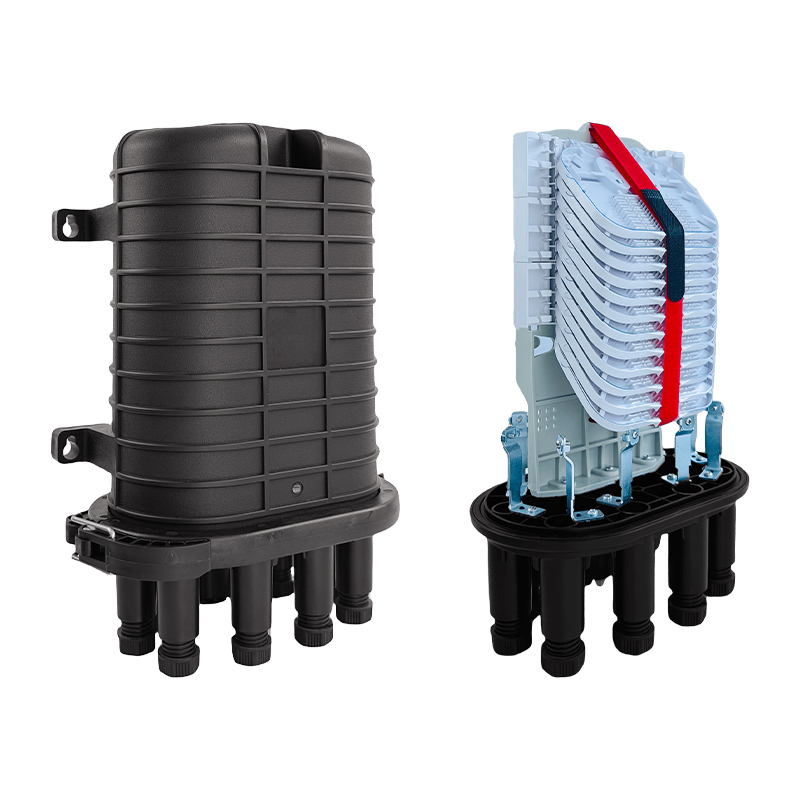
Mechanical compression seals and splice trays in a dome closure
Heat-shrink ports use adhesive-lined tubing that shrinks onto the cable and the port spigot. They can make a very tight, durable seal when the cable is clean, the heat is applied evenly, and the adhesive visibly fillets at both ends. They are less convenient when the same port will be opened several times, and they are harder to inspect after the fact if the shrink was under-heated or contaminated with mud or moisture during installation.
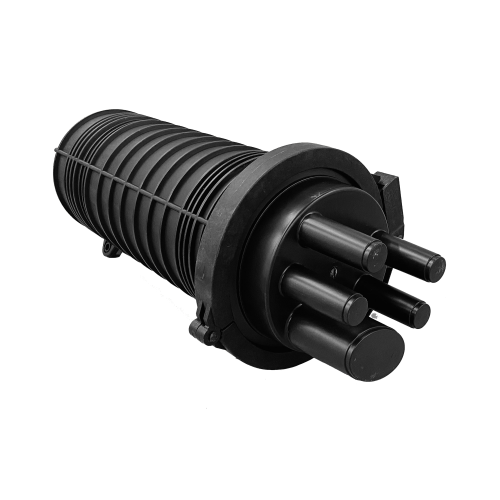
Heat-shrink cable-port spigots on a dome closure
A practical rule used on many outdoor jobs:
Use mechanical seals where the closure will be re-entered, where drop counts will grow, or where crews cannot reliably control a heat gun in wind, rain, or a confined pit.
Use heat-shrink where the port is expected to stay closed for the life of the plant, the cable diameter is stable, and the crew is trained and equipped for it.
Do not mix informal methods (tape, raw mastic, leftover shrink from another cable size) with either system and still call the closure IP68.
The same closure family can often be ordered with either sealing kit. Specify the kit with the housing, not as a warehouse afterthought.
Cable-port planning is where many bills of materials go wrong. A “2-in 2-out” or “3-in 3-out” inline closure, or a dome with a set number of round ports plus an oval mid-span port, only works if the counts match the route for this joint and the next foreseeable tap.
When writing the specification, list every cable that will enter the closure on day one, then add:
At least one spare port for a future branch or a repair cable, fitted with a proper blank that is rated with the closure, not a temporary plug.
Diameter ranges for each port, so a 12 mm drop is not forced into a grommet meant for a 16–20 mm feeder.
Whether an oval port is required for mid-span loop-through.
Tray and splice capacity with margin — fiber count grows more often than the civil work is rebuilt.
Unoccupied ports are not “empty.” They are part of the sealed system. A missing or unseated blank is a leak path. Treat blanks as specified accessories, and keep spares in the same kit as the grommets.
Most field failures can be traced to a short list of installation errors. A specification should require these practices, and a supervisor should check them before the pit is closed or the pole crew leaves.
Clean, dry, and sized. Cable jackets must be clean and dry before they enter a grommet or shrink tube. Measure the jacket diameter; do not guess the grommet size from memory.
Strength members and bonding. Anchor strength members to the closure chassis as the manufacturer requires. Bond and ground metal members where the network design calls for it. A cable that can slide in the port will eventually break the seal.
Bend and drip. Leave a drip loop or a downward service loop so water on the cable does not run straight into the port. Respect the cable bend radius at the entry; a tightly kinked jacket can wrinkle a grommet and open a capillary path.
Housing seal. Inspect the O-ring or gasket for nicks, dirt, and twist. Tighten clamps or bolts in the recommended sequence and torque. Do not “snug it by feel” on a dome that the datasheet rates in newton-metres.
Re-entry discipline. Every time a closure is opened, the housing seal and any disturbed cable port must be rebuilt, not just the tray work. Mid-span wraps and mechanical glands that were moved to add a drop need the same care as the first installation.
Record what was built. Note cable identities, port assignments, mid-span status, and any unused blanks. That record is what makes the next visit safe.
These steps sound basic. They are also the difference between a closure that stays dry through freeze-thaw and one that is replaced years early.
A useful closure RFQ is more than “IP68 dome, XX fibers.” At minimum it should state:
Mounting and body type — dome or inline; aerial, wall, duct, or buried.
Fiber and tray capacity, with spare splice positions.
Cable-port plan — number of in and out ports, oval mid-span port if required, diameter range for each cable, and the number of factory blanks.
Sealing system — mechanical, heat-shrink, or a defined mix — and whether mid-span sealing must be re-enterable.
Operating environment — temperature range, UV exposure, chemical or salt-laden air, and expected re-entry frequency.
Test and documentation — the standard against which the assembled closure is rated, plus a requirement that unused ports be fitted with matching blanks.
Category-level requirements like this let a manufacturer propose a dome or inline closure that actually matches the route, instead of a generic high-count housing that is then adapted on site with the wrong kit.
FiberMint manufactures fiber optic splice closures, distribution boxes, and terminal boxes for outdoor and indoor ODN plant, including dome and inline bodies, mechanical and heat-shrink port sealing, and mid-span access kits. If you are planning a new joint, a live-cable tap, or a standard closure specification for a multi-site rollout, send the cable list, port plan, and environment to Fibermint or lance@fibermint.com. We can help match the housing, the sealing kit, and the mid-span method to the route before the first closure is opened in the field.


